By Chee Chee Dumas | Chee Chee’s Corner
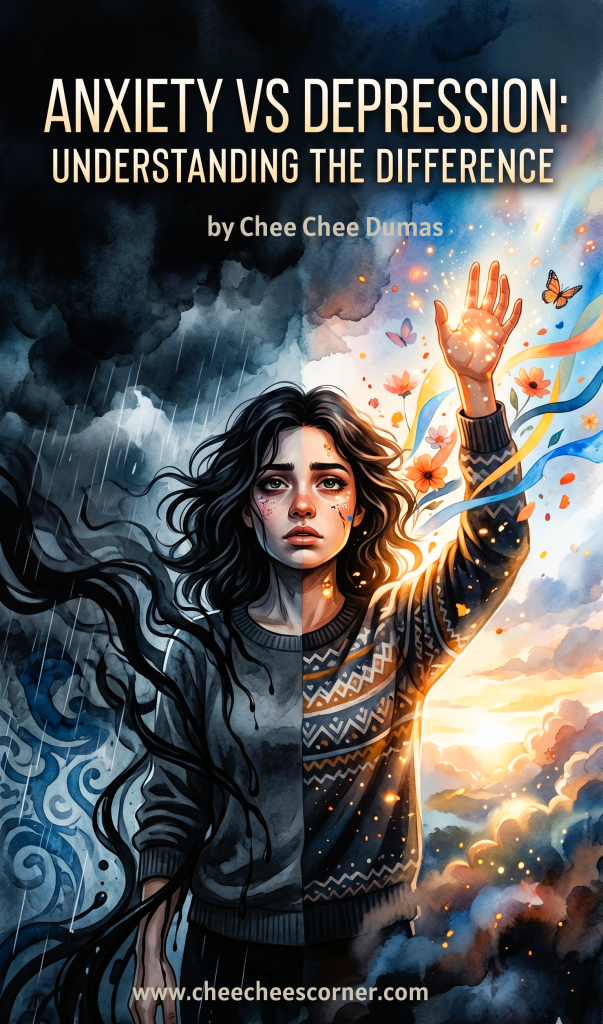
Mental health matters, and understanding what we feel can help us respond with more compassion, clarity, and support, both for ourselves and for others. While anxiety and depression can sometimes look similar or even happen together, they are not the same. Knowing the difference can be an important step toward awareness, healing, and seeking the right help.
What is Anxiety?
Anxiety is often rooted in excessive fear, worry, or nervousness, especially about what might happen next.
Common signs of anxiety:
• Constant overthinking or racing thoughts
• Feeling restless, tense, or unable to relax
• Rapid heartbeat or shortness of breath
• Sweating, shaking, or dizziness
• Trouble sleeping because the mind feels “too loud”
• Difficulty focusing due to persistent worry
Core feeling: “Something bad might happen.”
What is Depression?
Depression often goes beyond sadness. It can feel like emotional heaviness, emptiness, or losing interest in life itself.
Common signs of depression:
• Persistent sadness or emotional numbness
• Loss of interest in things once enjoyed
• Fatigue or low energy
• Feelings of hopelessness or worthlessness
• Sleeping too much or too little
• Changes in appetite
• Difficulty concentrating or making decisions
Core feeling: “What’s the point?”
Key Difference
• Anxiety often feels like fear about the future
• Depression often feels like hopelessness in the present
📖 Wisdom from Self-Help Thinkers in My Own Journey
Five years ago, when I sat for the LET exam, anxiety overwhelmed me. I was terrified of failing, and my thoughts spiraled endlessly. I kept asking myself, What if I fail? What will people think? Will they laugh at me? How could someone like me, a first honor pupil in grade school and a class valedictorian in high school, fail her board exam? That fear of judgment consumed me. Depression followed closely behind, whispering that I was stuck in a loop with no way forward. I questioned where my life was heading. Was I meant to live abroad or stay here? How would I organize everything when the future felt so uncertain? I worried about my children’s future, about our daily life, about being trapped without direction.
Part of my depression also came from my faith. I was raised as a Roman Catholic, and I dreamed of my children’s baptism, their first communion, the milestones of faith that had shaped my own childhood. But I knew it was not going to happen. My husband believed religion should not be part of our family life, and that our children should decide for themselves when they were old enough. For years, I carried sadness for something I could not control. I wanted to instill in them the love of God, to let them know there is a God they can pray to, a God who can protect them. Eventually, I realized I could only ask God and let God. As time passed, I found gentle ways to introduce my children to prayer. I read them Bible stories without pressure, without fear of being caught. I wanted to establish that faith would never be a problem in our marriage, never the reason for misunderstanding, but instead something my children could freely embrace when they were ready.
When I later discovered Mel Robbins’ The 5 Second Rule, I realized how powerful it could have been during those anxious moments. Even though I did not know it then, her idea of interrupting fear with a countdown became a tool I now use in daily life. When depression makes me feel paralyzed, I count 5-4-3-2-1 and push myself to take one small step, whether it is cooking for my family, organizing my notes, or simply opening the curtains. Those small actions remind me that I am not powerless.
Jordan Peterson’s 12 Rules for Life gave me another kind of strength. His words about standing up straight with your shoulders back reminded me that responsibility is not a burden but a source of meaning. I realized that my first duty was to take care of my health and to focus on what truly mattered, which was my family, especially my children. Peterson taught me that life is suffering, but meaning allows us to endure. I began to accept that some things are not within my control, like other people’s opinions or the uncertainty of the future. What I could control was how I faced each day, how I cared for my children, and how I resolved problems one at a time.
Dale Carnegie’s lessons also resonated with me when I read his book later on. His advice to live in “day-tight compartments” reminded me not to carry tomorrow’s burdens into today. Looking back, I realized that during those anxious nights before the exam, I had been trying to carry the weight of the future all at once. Carnegie’s wisdom helped me see that peace often comes from focusing only on what is in front of us.
Together, these thinkers gave me a way to reinterpret my past struggles and to face my present challenges with more strength. Carnegie taught me presence, Robbins taught me action, and Peterson taught me meaning. Their wisdom became more than words. It became a way of living. Anxiety and depression did not disappear, but I learned to meet them differently, with courage, responsibility, and faith that even small steps could lead me out of the storm.
Important to Know
• A person can experience both anxiety and depression at the same time
• Both are real mental health conditions, not weakness
• Self-help books can offer guidance, but professional support is also important
• Healing often comes from a combination of knowledge, action, support, and grace
Final Reflection
For me, healing was not about eliminating every anxious thought or dark day overnight. It was about learning how to respond differently. Dale Carnegie taught me how to challenge worry. Mel Robbins taught me how to move when I felt emotionally frozen. Both reminded me that while mental struggles are real, we are not powerless within them.
Sometimes, the first victory is not feeling instantly better. Sometimes, it is simply choosing not to give up today.
Remember:
Anxiety worries about tomorrow. Depression struggles with today. Healing begins when we choose, even in small ways, to fight for ourselves now.
Sources:
• Mel Robbins, The 5 Second Rule
• Jordan Peterson, 12 Rules of Life
• Dale Carnegie, How to Stop Worrying and Start Living
• National Institute of Mental Health (NIMH)
• World Health Organization (WHO)
• American Psychiatric Association (APA)
 CHEE CHEE'S CORNER
Leave a comment